
Living on the Outer Banks means dealing with salt air, high winds, and wind-driven rain every year. Your windows take the brunt of it.
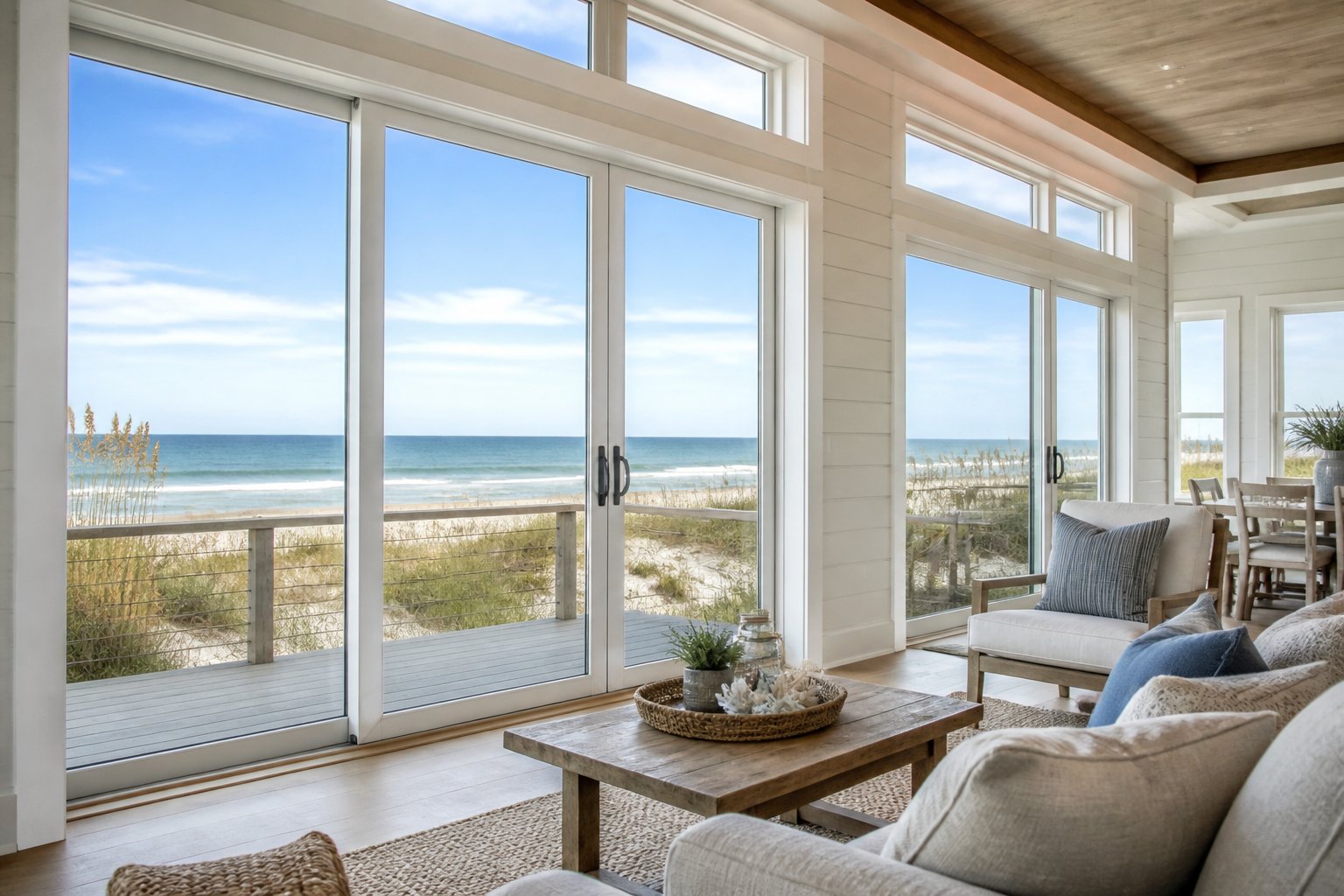
For most OBX and Ocracoke homes, the best choice is an impact-rated window with laminated glass, a Performance Grade (PG) and design pressure rating that matches your site’s wind zone, and a corrosion-resistant frame like fiberglass, composite, or coastal-grade vinyl. That combination handles hurricane winds and flying debris while keeping water out during long, soaking storms.
Building codes in Dare County and Hyde County set minimum standards, but the right window depends on where your house sits. An oceanfront home on Hatteras Island faces different pressures than a soundside cottage in Ocracoke.
Below, you’ll find how impact glass, Low-E and insulated glass, and frame materials compare so you can pick windows that hold up on the coast.
Choosing the Right Windows for OBX & Ocracoke
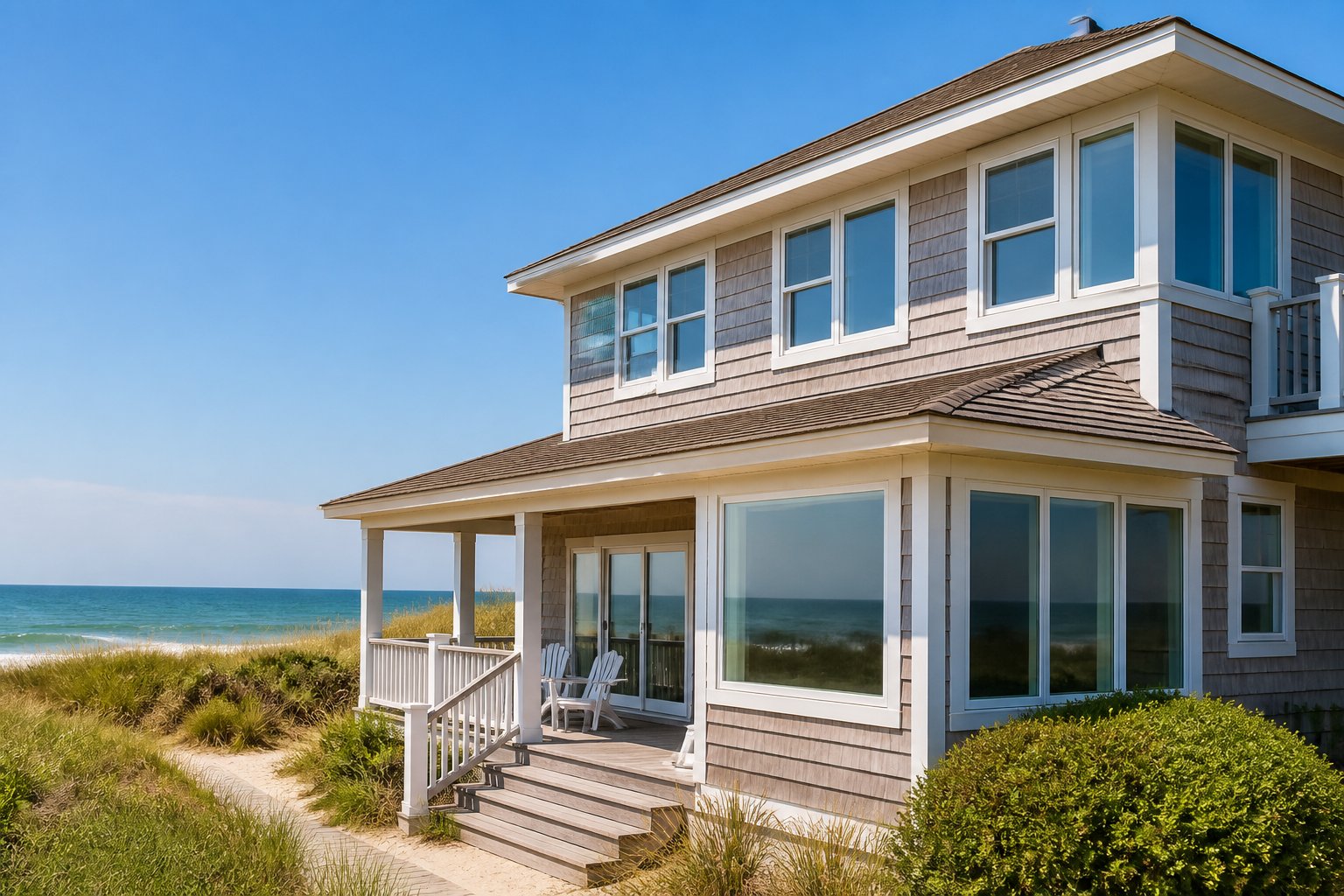
Picking windows for a home in Dare or Hyde County comes down to three numbers on the label: the design pressure rating, the impact rating, and the water penetration rating. Each one tells you how the window will hold up when a storm pushes wind, debris, and rain against your house at the same time.
Design Pressure and Performance Grade Ratings
Design Pressure (DP) measures how much wind load a window can take before it fails. Performance Grade (PG) is a broader rating that bundles structural strength, water resistance, and air leakage into one number.
A PG50 window, for example, has been tested at roughly 50 pounds per square foot of pressure. That’s about a 140 mph wind gust.
Here’s how ratings generally line up with OBX locations:
| Location | Typical wind zone | Common rating range |
|---|---|---|
| Sound-side, Kill Devil Hills | 130–140 mph | DP40–DP50 |
| Oceanfront Nags Head, Duck | 140+ mph | DP50 and up |
| Hatteras Island, Ocracoke | 140–150 mph | DP50+, often impact-rated |
Your building inspector will confirm the minimum for your lot. Corner windows and upper floors usually need higher ratings than ground-floor units on the lee side.
Impact Glass and Laminated Glass Protection
Impact-resistant windows use laminated glass: two panes bonded to a clear plastic interlayer, usually PVB or SentryGlas. When something hits it, the glass cracks but stays attached to the interlayer instead of falling out.
That matters because a broken window during a hurricane lets wind inside. Pressure builds fast and can push against your roof from below.
Look for products tested to the large missile impact standard, which fires a nine-pound 2×4 at the glass at about 34 mph. Many manufacturers list Florida Product Approval or Miami-Dade Notice of Acceptance numbers, and those certifications carry weight here too.
Impact glass also removes the need to put up shutters or plywood before every storm. Some insurance carriers offer discounts on wind coverage when you install certified units, so ask your agent before you buy.
Water Resistance Against Wind-Driven Rain
Wind-driven rain is a separate problem from wind pressure. Rain moving sideways at 60 mph finds gaps that a vertical downpour never would.
Window water ratings are shown as a pressure number, often written as WTP. A window rated for water at 7.5 psf handles heavier driving rain than one rated at 4.5 psf.
Three things drive real-world performance:
- Sill pan flashing that directs any water that gets past the frame back outside
- Sloped sills and weep holes that drain instead of trapping water
- Flexible flashing tape integrated with the house wrap in the right order
Installation matters as much as the window itself. A high-rated unit set into a poorly flashed opening will still leak, and salt air speeds up corrosion once moisture reaches the framing.
Choosing Frames, Glass, and Hardware for the Coast
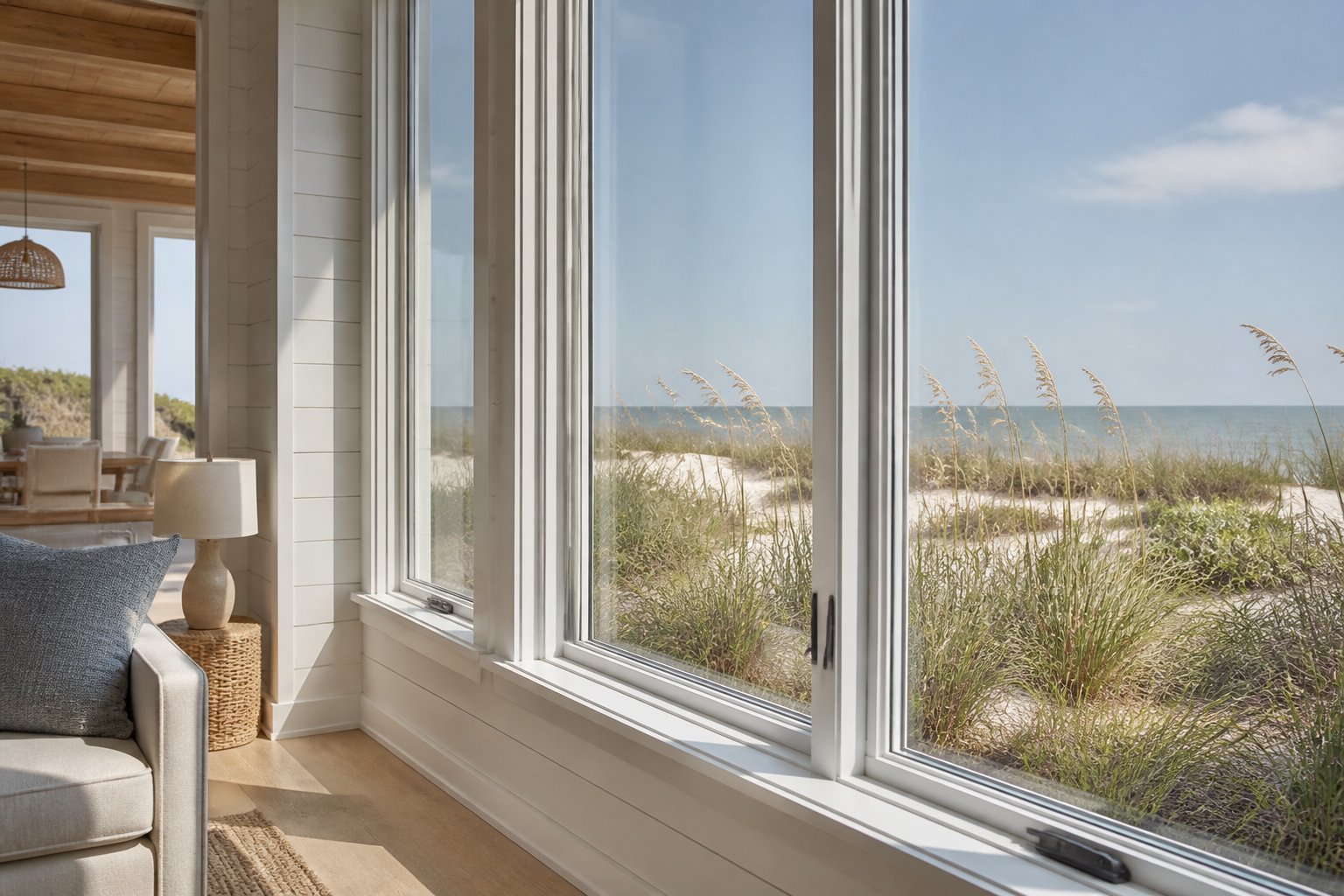
On the Outer Banks, your window is only as strong as its weakest part. The frame has to shrug off salt air and humidity, the glass needs to block UV rays and cut heat gain, and the hardware has to keep working after years of exposure.
Vinyl, Composite, Fiberglass, and Clad Wood Frames
Frame material decides how your windows age in Dare and Hyde County salt air.
Vinyl doesn’t rust or corrode, and it costs less than most alternatives. It works well for standard-size openings, but it flexes more, so check the design pressure rating before using it on a large or wind-exposed wall.
Fiberglass expands and contracts at nearly the same rate as glass, which helps seals last. It also holds paint well and stays stable in high humidity.
Composite frames blend wood fiber with polymer. You get more strength than vinyl without the rot risk of solid wood.
Clad wood gives you a wood interior with an aluminum or fiberglass exterior. It looks great in an Ocracoke cottage, but the cladding finish matters — a factory-applied finish handles salt spray better than a field-painted one.
| Frame | Salt air resistance | Best use on the coast |
|---|---|---|
| Vinyl | Excellent | Budget-conscious replacements, standard openings |
| Fiberglass | Excellent | Large units, high-wind elevations |
| Composite | Very good | Mid-range projects wanting extra strength |
| Clad wood | Good (finish-dependent) | Interior wood look, oceanfront with regular rinsing |
Low-E and Insulated Glass for Comfort and UV Control
Insulated glass units use two panes with a sealed air or argon space between them. That gap slows heat transfer, which matters during long Hatteras Island summers.
Low-E coatings are thin metallic layers on the glass. They reflect infrared heat and block a large share of UV rays, so your floors, rugs, and furniture fade more slowly.
On south- and west-facing walls, ask for a lower solar heat gain coefficient (SHGC) to reduce afternoon heat. On the sound side, where views matter most, balance SHGC against visible light so the glass doesn’t look dark.
Low-E can be combined with laminated impact glass, so you don’t have to choose between storm protection and energy performance.
One note: the insulated unit’s edge seal is a common failure point in humid coastal air. Ask about the warranty period for seal failure and fogging.
Corrosion-Resistant Hardware and Locking Systems
Standard hardware often fails before the frame does. Zinc-plated or painted steel parts pit and seize within a few seasons of salt exposure.
Look for these upgrades:
- 316 stainless steel hinges, screws, and operator arms — 316 handles chlorides better than the more common 304
- Multi-point locking systems that pull the sash tight at several points, improving both water resistance and design pressure performance
- Sealed or coated operators on casements, since exposed gear teeth collect salt
- Stainless or composite balance hardware on double-hungs
Rinse hardware, tracks, and weep holes with fresh water a few times a year, and more often after storms. Salt deposits build up quietly, and a two-minute rinse extends hardware life considerably.
Matching Window Protection to Island Exposure
Not every Outer Banks home faces the same risks. A soundside cottage in Manteo deals with different pressures than an oceanfront house on Hatteras Island, and those differences change which design pressure ratings, glass types, and frame materials make sense for your project.
Oceanfront and Soundside Conditions in Dare County
Oceanfront homes in Dare County take the hardest hit. Windows facing the beach in Nags Head, Kill Devil Hills, and Kitty Hawk deal with direct wind loads, blowing sand, and constant salt spray.
For these walls, you generally want the highest design pressure your budget allows, plus laminated impact glass on any opening that could be struck by debris.
Soundside homes face a different mix. Wind speeds are often lower, but wind-driven rain from the west during a storm’s back side can push water into weak frames and poorly sealed joints.
| Exposure | Main Concern | What to Prioritize |
|---|---|---|
| Oceanfront | Debris, high wind loads, salt spray | Impact glass, high PG rating, corrosion-resistant hardware |
| Soundside | Wind-driven rain, flooding | Strong water resistance rating, quality sill pans and flashing |
Tip: Ask your installer for the specific PG number on each unit, not just a general “hurricane-rated” label.
Hatteras Island Wind and Salt Exposure
Hatteras Island sits far out into the Atlantic, so homes here see stronger sustained winds than the northern beaches. Building codes in this part of Dare County reflect that with higher wind speed requirements.
Salt air corrosion is a bigger factor too. The narrow island means salt reaches nearly every property, not just the front row.
Vinyl, fiberglass, and composite frames hold up well because they don’t rust. Pay close attention to hardware, screens, and fasteners, since these metal parts often fail before the frame does.
Rinsing frames, tracks, and hardware with fresh water a few times a year removes salt buildup and extends the life of your coastal impact windows.
Ocracoke and Hyde County Considerations
Ocracoke is reachable only by ferry, which shapes your window decisions in practical ways. Replacement parts, service visits, and emergency repairs all take longer, so choosing durable products with strong warranties matters more here.
Ocracoke also sits in Hyde County, so permit requirements and inspections run through a different office than the rest of the Outer Banks. Confirm local wind speed and design pressure requirements before ordering.
Homes on the island face storm surge and sound-side flooding, along with heavy salt exposure on all sides.
Impact glass is worth considering here for another reason: it removes the need to install shutters or plywood before a storm, which is difficult if you only visit the island seasonally.
Installation Details That Protect the Building Envelope
A hurricane-rated window only performs as well as the wall opening it sits in. On Hatteras Island and Ocracoke, wind-driven rain arrives sideways at 60 to 100 mph, so flashing, anchoring, and the choice between a retrofit and a full-frame install decide whether water stays outside.
Proper Flashing and Sealing at Every Opening
Water always wants to move down and in. Your job is to give it a path back out.
Start with a sloped sill pan, either a pre-formed pan or self-adhered membrane with a back dam.
Then shingle the flashing correctly: sill first, jambs next, head flashing last, lapped over the housewrap.
Details that matter on OBX homes:
- Sill pan flashing with an end dam at each corner
- Weather-resistive barrier lapped over head flashing, not tucked under it
- Backer rod and sealant at the exterior perimeter, three-sided bead only
- Stainless steel fasteners to resist salt air corrosion
- Low-expansion foam or backer rod in the shim space, not packed tight
Leave the bottom of the exterior perimeter joint unsealed so any water that gets in can drain out.
Replacement Versus New-Construction Window Installation
Two approaches, two very different results.
Insert (pocket) replacement keeps the existing frame and exterior trim. It is faster and cheaper, but you inherit whatever flashing is already there — and you lose about an inch of glass area on each side.
Full-frame (new-construction) replacement removes the old unit down to the rough opening. You can inspect the sheathing for rot, install new flashing, and mount a nail-fin unit that ties into the drainage plane.
| Insert | Full-Frame | |
|---|---|---|
| Existing flashing replaced | No | Yes |
| Rot inspection possible | Limited | Yes |
| Glass area | Reduced | Maintained |
| Typical cost | Lower | Higher |
For oceanfront and soundfront homes, full-frame installation is usually the better choice. This is especially true if the original windows are 20 years old or showing water stains at the sill.
Coordinating Window and Door Installation
Doors take more abuse than windows. They sit lower, catch splash-back from decks, and have a threshold instead of a sealed sill.
Schedule window and door installation together so one crew handles the whole drainage plane. Mixed crews and split schedules create gaps at the transitions — especially where a slider meets a window wall.
Ask your installer to confirm:
- Threshold pan flashing under every exterior door
- Matching design pressure ratings for units in the same wall
- Anchor spacing per the manufacturer’s approved installation instructions
- Continuous WRB laps across adjacent openings
- Hardware and anchors rated for coastal exposure
Keep the manufacturer’s installation instructions and approval documents on site. Dare County and Hyde County inspectors will ask for them, and your insurance carrier may too.
Brands, Doors, Maintenance, and Purchase Planning
Picking the right window brand matters on the Outer Banks. So does choosing doors that lock tight and planning for salt air upkeep.
Here is what to look at before you sign a contract.
Evaluating Andersen and Andersen 400 Series Options
Andersen is one of the more common brands on OBX homes. Local companies like Macko Construction serve as authorized service providers for the line.
The Andersen 400 Series with Stormwatch protection is built for coastal spots. These units add design pressure upgrades, extra silicone glazing, reinforced frames and sashes, and special fasteners.
Glass choices include High-Performance and High-Performance Sun impact-resistant glass, plus clear and tinted monolithic impact glass. Impact-resistant glass in the line carries a 10-year limited warranty.
Other brands sold locally include Pella, Viwinco, JELD-WEN, and Renewal by Andersen.
Ask any installer for the design pressure (DP) rating and Performance Grade (PG) on the exact model quoted, not just the brand name. Ratings vary widely within a single product line.
Impact-Rated Doors and Multi-Point Security
Doors take the same wind and water pressure as your windows. They need matching ratings.
Sliding patio doors and swing doors on the sound or ocean side should be impact-rated with laminated glass. Look for a PG rating that matches or beats your window specs.
Multi-point locking systems pull the door tight against the frame at three or more spots. Standard hardware uses a single latch point, which leaves the top and bottom of the panel free to flex during a storm.
That flex is how wind-driven rain gets in. Multi-point locks also help the weatherstripping seal evenly along the whole edge.
Ask for stainless steel or coated hardware. Regular steel rusts fast in salt air.
Maintenance Needs, Warranties, and Project Budget
Different frame materials need different care:
| Frame | Upkeep |
|---|---|
| Vinyl | Rinse twice a year; no painting |
| Fiberglass | Rinse and repaint every 10–15 years |
| Composite | Rinse; minimal upkeep |
| Clad wood | Check interior wood finish; inspect seals |
Rinse all exterior hardware and tracks with fresh water a few times a year to slow salt air corrosion. This applies to screens, hinges, and locks too.
Read the warranty closely. Glass, frame, and hardware often have separate terms, and some warranties shrink for homes within a set distance of the water.
For budgeting, expect impact-rated units to cost noticeably more than standard windows. Get at least three quotes that list the model number, DP rating, glass type, and full installation with flashing.
Frequently Asked Questions
Choosing windows for the Outer Banks comes down to a few key details: impact ratings, design pressure numbers, frame material, and water performance.
Below are answers to the questions homeowners in Dare County and Hyde County ask most often.
What type of windows are best for homes in coastal North Carolina?
The best choice is an impact-rated window with laminated glass, a corrosion-resistant frame, and a Performance Grade high enough for your site.
For most OBX homes, that means fiberglass, composite, or vinyl frames with stainless steel hardware and Low-E insulated glass. Clad wood works too, as long as the exterior cladding is aluminum with a strong factory finish and the wood interior stays protected from moisture.
Oceanfront and soundfront homes need stronger units than houses set back behind dunes or tree cover. Your builder or installer should check the wind zone for your specific lot, not just the town.
Do homes on the Outer Banks need hurricane-rated or impact-resistant windows?
In most cases, yes. North Carolina’s building code treats the barrier islands as a wind-borne debris region, which means openings must be protected by either impact-rated glass or approved shutters.
Dare County and Hyde County both enforce this for new construction and many replacement projects. Ocracoke and Hatteras Island sit in some of the highest wind zones in the state, so requirements there are stricter than on the mainland.
Even where code allows shutters instead, many owners pick impact glass so they don’t have to install panels before every storm. Rental property owners often prefer it for the same reason.
How do design pressure and Performance Grade ratings affect window selection in high-wind areas?
Design pressure (DP) measures how much wind load a window can handle before it fails, in pounds per square foot.
Performance Grade (PG) is a broader rating that covers structural load, water resistance, and air leakage together.
A higher number means a stronger window. Homes closer to open water usually need a higher rating than homes a few blocks inland.
Here’s how the two compare:
| Rating | What it measures | Why it matters on the OBX |
|---|---|---|
| DP | Structural wind load only | Tells you if the unit can take sustained hurricane winds |
| PG | Wind load, water, and air, tested as a system | Better predictor of real-world storm performance |
Ask for the PG number, not just DP. A window can carry a decent DP and still let water in during a driving rain.
Your local building inspector can tell you the minimum required for your address. Buying above the minimum is common on oceanfront lots.
Are laminated impact-glass windows better than hurricane shutters for coastal homes?
Each has trade-offs. Impact glass protects the opening all the time, with no setup needed, and it also cuts noise and blocks most UV light.
Shutters cost less upfront and can be added to windows you already have. The downside is that someone has to close them, which is hard if you live off-island or rent the house out.
Some owners use both: impact glass on the windows facing the ocean, and shutters on less exposed sides. That approach controls cost while covering the highest-risk openings.
Laminated glass also holds together when it breaks, since the plastic interlayer keeps the shards in place. That helps keep wind and water out of the house even after a hit.
Which window frame materials resist salt-air corrosion best: vinyl, fiberglass, composite, or clad wood?
Salt air is hard on metal parts, so hardware matters as much as the frame itself.
- Vinyl — Doesn’t corrode or rot. Low maintenance and lower cost. Can expand and contract with heat, so quality of the weld and reinforcement matters.
- Fiberglass — Very stable in heat and humidity, and it doesn’t rust. Holds paint well and expands at nearly the same rate as glass.
- Composite — Blends wood fiber and polymer. Resists warping, cracking, and rot, and handles salt exposure well.
- Clad wood — Aluminum exterior over a wood interior. Looks good and insulates well, but the cladding finish has to be rated for coastal use or it can pit and chalk.
Whatever frame you pick, ask for stainless steel or coastal-grade hardware. Standard zinc or plain steel parts can corrode within a few seasons near the ocean.
Rinsing frames and tracks with fresh water a few times a year also extends their life.
What water-resistance and wind-driven-rain ratings should replacement windows have for Ocracoke and Hatteras Island homes?
Look at the water penetration resistance number, listed in pounds per square foot on the window’s performance label.
This number shows the pressure at which water starts getting through during testing.
For exposed sites on Ocracoke and Hatteras Island, a higher water rating is worth the extra cost.
Wind-driven rain is often what causes damage, not just the wind itself.
Air infiltration matters too.
A tighter unit keeps out both moisture and the humid air that drives up cooling costs during the long Outer Banks summer.
Installation affects performance as much as the product.
Proper flashing, a sloped sill pan, and sealed joints are essential to keep water from getting behind the frame.
A well-rated window installed poorly will still leak.
